
The Derivatives
By the effect of free market economy, there are several risks that might occur, such as financial risk, maturity risk, exchange risk, which is why natural and legal persons are exposed to huge risks. For this reason, people, financial institutions and companies should protect themselves from these kinds of risks and get an appropriate position. Derivatives play a significant role in preserving a legal or natural entity against maturity and exchange risks. So, the new sequence of articles is initiated by this article. In the following titles, the kinds of derivatives will be explained and a legal perspective will be drawn regarding them.
Forward Agreements
An agreement which gives a right or an encumbrance to buy/sell a good, a security or an exchange at a predetermined price.1
The most important function of this agreement type is preserving the buyer or seller from risks which are drops or increases of price of contract goods.
There are two risks in forward agreements:
- To fail to comply with payment in due time.
- A misestimation of future prices of contract goods.
There are three purposes to make forward agreements: Speculation, Hedging, and Arbitrage.
Speculation:
Some investors make estimations on future prices of some goods. In this way, they enter into a forward agreement with the aim to make a profit. For example, if an investor expects that the price of coal will decrease in a time, he will buy a forward agreement on coal and when the expiration date occurs, if the price decreases, the investor will be entitled to buy the coal at pre-concerted price and make a profit.
Hedging:
Hedging means an investor will guarantee himself against maturity risk. For instance, an investor dealing with gas trade might enter into a forward agreement in order to prevent losses arising from price gaps.
Arbitrage:
Arbitrage is the process of simultaneous buying and selling of an asset from different platforms, exchanges or locations on different prices (usually small in percentage terms) by cash. While getting into an arbitrage trade, the quantity of the bought and sold underlying asset should be the same. So, while an investor enters into a forward agreement that gives a right to buy oil to the owner, he might be able to perform another transaction on oil on a different platform at the same time.
In the case, that this transaction is an agreement, it gives several rights and imposes obligations. Therefore, parties cannot renege on this agreement without the consent of the counterparty. Actually, parties cannot terminate this agreement prior to the expiration date, independently of the consent of the counterparty. Parties can extend the term of the contract provided that they mutually agree on this.2
There are not any options to terminate a forward agreement prior to the expiration date. At the expiration date, the agreement will be automatically terminated by delivery. When the agreement expires, the buyer or seller must comply with his commitment at the pre-concerted price.
By delivery of the good in return for the pre-concerted price, the agreement will be over.
A reverse transaction prior to expiration date (Offset) is an option to get rid of the effects of a forward agreement instead of rescission. A party (it can be buyer or seller of the agreement) can enter into another forward agreement on same goods but in reverse location. It means that a buyer must be the seller in another agreement to make an offset transaction. In this way, the investor can preserve his financial statement.
Parties can independently identify the maturity period, exchange type and etc., because of the trait that these agreements are private commercial agreements.
Despite the fact that forward agreements are flexible, parties must comply with making the transactions on the negotiated price as per the agreement. For instance, an investor has bought a forward agreement imposing that the investor will buy an oil barrel at the price of 100 USD six months later, the investor must comply with this commitment no matter the future price of an oil barrel. If the price of an oil barrel will be 90 USD six months later, an investor will have been made 10 USD profit, because the seller must sell that barrel at this price according to the agreement. Conversely, if an oil barrel's price will increase to 110 USD, the investor will have been made a loss of 10 USD. Because the investor must buy the barrel at this price in spite of that the actual price is lower six months later.
Forward agreements are processed in Over-The-Counter markets. This factor makes forward agreements more flexible, therefore they are not standard. Forward transactions can be processed between natural entities and legal entities. There is not any restriction on type of parties.
There is not any guarantee, such as clearing room, for forward agreements.
Besides that, forward agreements cannot be transferred to third parties. Thus, there is not a secondary market for forward agreements. Consequently, forward agreements are based on trust.4
Future Agreements
The definition of futures agreements generally does not vary from the definition of forward agreements which is an agreement that gives a right or an encumbrance to buy/sell a good, a security or an exchange at a predetermined price. Despite the fact that the definitions of these agreements are the same, there are important differences between these agreements, such as markets that agreements are processed in, standardization, amount of the agreement, traits of maturity periods and so on.
Future agreements are processed in organized markets, standardized by the stock market, which is one of the most important differences from forward agreements.
Maturity, magnitude, collaterals are determined and standardized by the stock market. Therefore, the risk of future agreements is lower compared with forward agreements. Moreover, the default risk is eliminated by organized markets.
Clearance houses are constituted for future agreements. Payments are made in clearance houses, therefore process of future agreements are guaranteed by clearance houses. Clearance houses serve as Official parties in future agreements. A purchaser puts forth his bid and a buyer puts forth his offer. When the parties come to an agreement they inform the clearance house. The clearance house asks the parties for a credit as an initial margin in order to restrict and control the insolvency risk. The clearance house confirms the official price of the agreement at the end of each working day. If the price drops beneath of the initial margin, the clearance house asks for a maintenance margin.5
Future agreements are closed in three ways:6
- The underlying/based goods are sold or bought at the predetermined price. This closing rarely appears in markets.
- Cash Delivery: Some contracts are not permitted to physical delivery by the stock market. These agreements are closed in cash in the light of the rules imposed by the stock market.
- Offsetting: A seller purchases another future agreement which is the same in the meaning of the good, maturity and other technical traits.
There are main advantages of future agreements. Risk transfer, elimination of uncertainty, liquidity, transparency can be taken as an example. Having said that, there are two main drawbacks of future agreements. Firstly, the necessary to deposit an initial margin brings about an additional encumbrance to parties.
Secondly, since amounts and maturities of future agreements are standard, the possibility to purchase or buy a future agreement to cover the risk is not so high.7 While the transaction is being executed, purchaser and seller should deposit a commission to the clearance house in a certain amount of the transaction.
As it was mentioned aforesaid, liquidation is possible for future agreements. Since the future agreements can be purchased or sold prior to expiration date, the parties can liquidate the agreements whenever they desire. This factor makes future agreements transferable to third parties, consequently they are reasonable for speculators.8
If the differences between future and forward agreements are set forth, the following can be counted:9
| Differences | Future Agreements | Forward Agreements |
|---|---|---|
| Market | Organized markets | Over-the-counter markets |
| Magnitude of an Agreement | Standard | Determined by parties |
| Expiration Date | Standard | Determined by parties |
| Collateral | Initial margin and maintenance margin | Under the initiative of the counterparty |
| Credit Risk | Clearance House | Customer |
| Advance Payment | In the amount of the initial margin | None |
| Closing | With Clearance House | With counterparty |
| Termination | Generally offsetting | The rule is fulfilling the commitment |
To sum up, future agreements are made for risk management as other derivatives are.
Being clearance houses as a part of future agreements, makes them more secure with regard to an insolvency risk and a default risk. However, relatively a stricter structure of future agreement markets brings about a limit at the number of future agreements.
Option Agreements
Option agreements can be briefly defined as “an agreement which is conducted between purchaser and seller and gives an option to purchase or sell the underlying asset (the right to use the option) to the user within or until a certain term in return for a certain premium.” The most important point in this definition is these agreements give an option to purchase or sell; not to give an obligation to purchase or sell.10 The aforementioned definition contains many components which account for the main structure of option agreements. There are many key facts should be explained in the definition in question:
The Parties of Option Agreements
Purchasing (Long) Party
The purchasing party has a right to use the purchasing or selling option. Since this party does not have any obligation other than paying a premium, it does not carry any risk.
Actually the purchasing party has two options: Purchasing or selling an asset.
The word of purchasing in the definition is to purchase an option agreement; not the right to purchase an asset. For instance, the purchased option agreement might give the purchasing party the right to sell an asset. In this example, the purchasing party has purchased an option agreement imposing a right to sell an asset. Therefore, the purchasing party will have an option to sell the underlying asset in return for the predetermined price.
The purchasing party can:
- Use the option.
- Sell the option before exercising it.
Under any circumstances, the purchasing party makes a loss at most equal to the premium paid initially.
However the possibility of profit is infinite.
Selling (Short) Party
The selling party is under the obligation to sell or purchase the underlying asset in case of the option is used by the purchasing party within due time or until maturity date. A deposit is demanded, since this party carries a default risk.
The same explanation that was made for purchasing party, is valid also for the selling party. Selling party might has sold an option to purchase an asset to a purchasing party. In this case, when the purchasing party uses the option to sell an underlying asset, the selling party should purchase the asset in question in return for the predetermined price.
The selling party can repurchase the option that was sold initially; hence the position will be closed. If the purchasing party does not use the option, the selling party makes a profit at the amount of the premium which was taken initially. Despite the fact that the possibility of profit can be at most at the amount of the premium, a possibility of loss is infinite.
The Kinds of Option Agreements Regarding the Subject
Call Option
This option gives the owner the right to purchase the underlying asset in return for the predetermined price within due time or until the maturity date. An increasing of the price of the asset is in favor of the owner of the call option. Because the owner of the call option has already agreed on the price of the asset, therefore, he can use the option to purchase the asset. Apart from the initially paying premium, the price gap between the predetermined price and price on maturity time constitutes the owner's profit. If the owner of the option opts to use the option, the seller should not refrain from selling the asset. Similarly, decreasing of the price of the asset is in favor of the seller. However, in this case the owner of the option might not use the option to purchase.
Put Option
This option gives the owner the right to sell the underlying asset in return for the predetermined price within due time or until the maturity period. The owner's expectation in case of having a put option is a decrease of the price of the underlying asset. Because in this scenario, the owner of the put option has already agreed on the price which is more expensive than the actual price. Apart from initially paying premium, the price gap between the predetermined price and price on maturity time constitutes the owner's profit. If the owner of the put option opts to use the option, the seller of the option should not refrain from buying the asset in return for the predetermined price.
In both options, the parties agree on four main provisions:
- The amount of the agreement
- The maturity of the agreement
- The price on the maturity date
- The premium paid by the purchasing party
On the date of the agreement, the purchasing party pays the premium. While this premium constitutes a cost for the purchasing party, it constitutes an income for the selling party. Whether the purchasing party uses the option or not, the purchasing party must pay this premium.
The Rights and Obligations of Parties Regarding the Options
| Party | Call Option | Put Option |
|---|---|---|
| Purchaser | The right to purchase the underlying asset if the option is used. | The right to sell the underlying asset if the option is used. |
| Seller | The obligation to sell the underlying asset if the option is used. | The obligation to purchase the underlying asset if the option is used. |
Types of Options Regarding to Maturity
European Type
In this type of option, the owner of the option should use the option at the maturity date; the option cannot be used prior to the maturity date.
American Type
In this type of option, the owner of the option can use the option until the maturity date.
The following can be counted as the primary factors affecting the price of an option:
- The price of the underlying asset
- The number of days to maturity
- The volatility of the underlying asset
- The market’s interest rate
Consequently, an option agreement is a type of hedging instrument. Like other instruments, there are several risks for both parties. But it should be borne in mind that the main characteristic of option agreements is that these agreements give a right to use an option, not an obligation. This factor makes option agreements more flexible and brings about a relatively wider market.
SWAP AGREEMENTS
As a type of risk management instrument, basically, a swap is a contract based on exchanges of payment flows.11 Despite the fact that there are several definitions made by scholars from different areas, swap agreements can primarily be defined as “a contract in which parties mutually undertake to make periodic payments independent from the principal transaction during the term of the contract.” Although the definition manages to draw a picture of swaps in our minds, it requires comprehensive explanations.
There are two types of swap agreements:
Interest Rate Swap and Currency Swap.
Despite the fact that these two types coincide on basic points, they are separate from each other on certain matters.
First of all, in interest rate swap agreements, parties mutually make payments by applying a special rate on principal amount during the contract term. But while a party uses a fixed rate for applying on principal amount, counterparty uses Variable interest rate such as LIBOR, EUROBOR, etc. Thus, parties make different amount of payments by applying different rates on the same principal amount. But the important thing is that the parties never pay the principal amount in question to each other. The principal amount is used only to calculate the amount payable during the term. Why, then, does an investor enter into this kind of agreement?
The answer depends on the principal transaction. An investor seeking to hedge may already be party to an agreement carrying a variable interest rate. By entering into a swap, the investor undertakes to pay a fixed rate in return for receiving the variable rate and thereby closes the exposure arising from the other agreement. The currencies of the payments are the same in interest rate swaps.
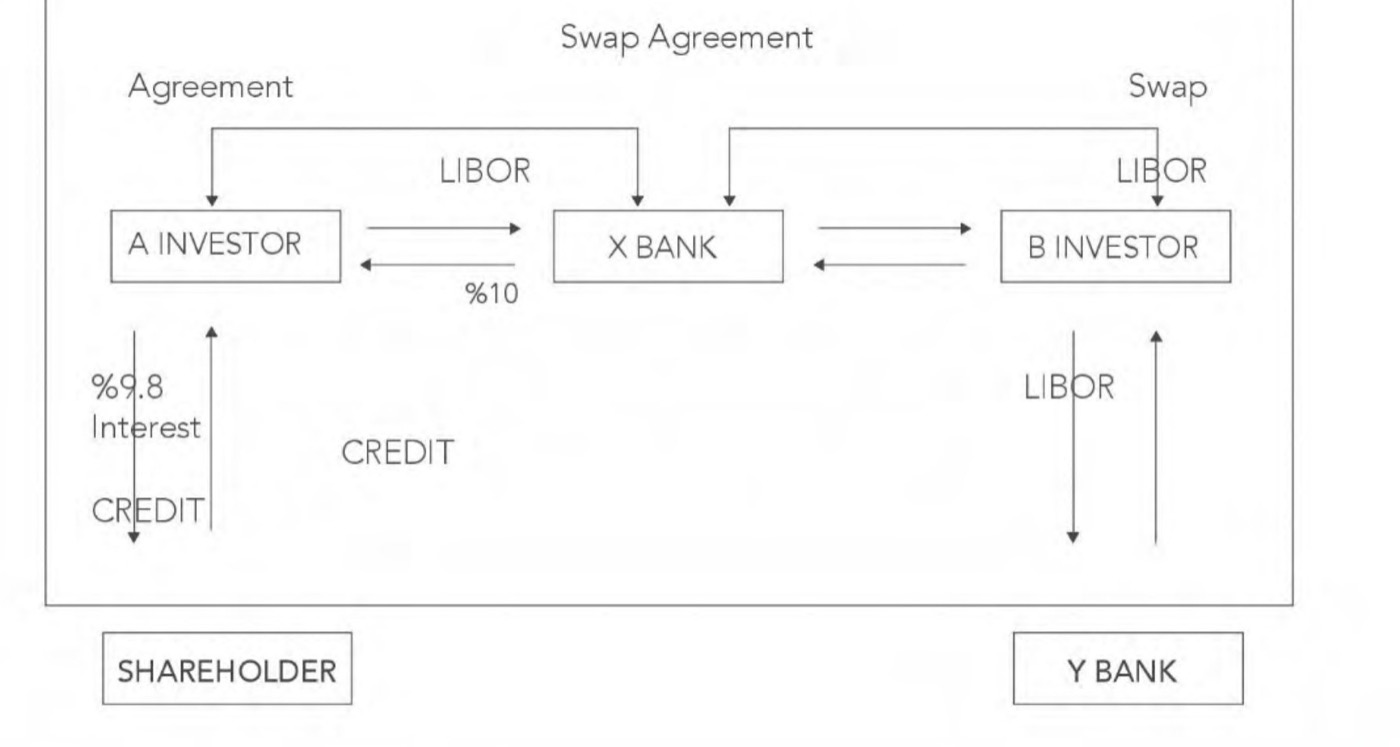
This feature differs in currency rate swaps since the purpose in currency rate swap is hedging by using currency risk.
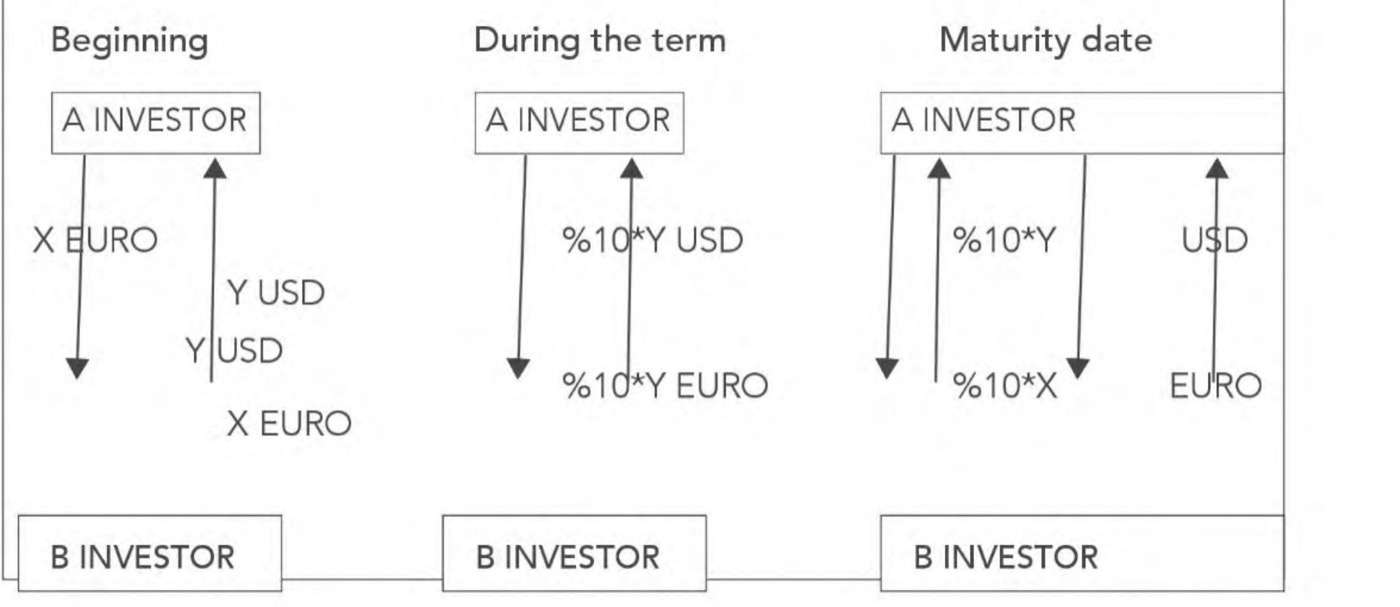
Secondly, the other type of swaps are currency swap agreements. In currency swap agreements, making payments can be divided into three stages: at the beginning of the contract, during the contract and at the maturity date. At both of the beginning and maturity date, parties pay nominal principal amounts to each other in different currencies. Besides that, parties agree upon a rate that will be applied on the principal amount and they pay calculated amount to each other during the period. Thus, parties close the agreement by making their payments in three stages.13 It must be emphasized that payments are made in different currencies. This is the main purpose of currency rate swaps.
There are several characteristic features of swap agreements. The followings can be counted as the main features of them:14
- The main important side of swaps is, that swap contracts are fully independent from principal transactions, which investors desire hedging risks arising from. This feature does not require an existence of a basic agreement in order to make a swap agreement. An investor can enter into a swap agreement even if there is not another main agreement.
- Essentially, in interest rate swaps, nominal principal amount plays its main role in calculating interest payment to be made during the contract. Especially, there is no other role of principal amount in interest rate swaps than calculating. But in currency swaps, the parties make payments to each other equal to principal amount both at the beginning and end of the term.
- Exchanging of payment flows does not mean that there is a barter transaction. Therefore, parties cannot terminate the contract by deducting their obligations. Parties undertake to make payments determined at the beginning. Parties neither transfer the contracts nor change their obligations.
- Parties should agree upon a term since the frequency of payments, the maturity of the term and other components are closely related with the term. It should be stated that the term plays a special role in currency swaps, since parties pay principal amounts to each other at the beginning and at the end of the term.
- There is not any standard of swap agreements and swap agreements are conducted in over the counter market.
As a result, a swap agreement is an instrument for risk management. Like other instruments, investors carry several risks in order to preserve themselves from bigger risks. Naturally, the investors might have special purpose by entering into a swap agreement such as hedging, speculation, arbitrage etc. It should be stated that there is always a default risk in swap agreements. This is one of the most important drawbacks of swap agreements.
References
- Don M. Chance, An Introduction to Options and Futures, The Dryden Press, Florida, 1989, p. 20.
- Ali Ceylan, Finansal Teknikler, Ekin Basın Yayın Dağıtım, Bursa, October 2003, p. 371.
- Batı, M., Are the Forward Contracts Tax Avoidance Tool?, p. 1220.
- İhsan Uğur Delikanlı, Forward Döviz İşlemleri Vasıtasıyla Mevduat Faiz Gelirinin Peçelenmesi, Vergi Dünyası, Issue 200, April 199; Haluk Erdemol, Bankalarda Dış Ticaret İşlemleri ve Uygulamaları, Akbank Ekonomi Yayınları, İstanbul, 1993.
- G. Küçükkocaoğlu, Türev Piyasaları – Vadeli İşlem Piyasaları Tanımı, Kuramsal Analizi ve Gelişimi, 2006.
- Ali Çakar, Türev Ürünler ve Vadeli İşlem Piyasaları, Ankara, 2009, p. 115.
- Ali Çakar, Türev Ürünler ve Vadeli İşlem Piyasaları, Ankara, 2009.
- Kerem Özşahin, Vadeli İşlem Sözleşmesinin Hukuki Niteliği, Ankara, 1999.
- Ali Çakar, Türev Ürünler ve Vadeli İşlem Piyasaları, Ankara, 2009.
- VİOP Tanıtım Kitapçığı, Borsa İstanbul.
- Carolyn H. Jackson, Have You Hedged Today? The Inevitable Advent of Consumer Derivatives, Fordham Law Review, 67 (1998–1999), p. 3208.
- Bank for International Settlements (BIS).
- Dilşad Keskin, Swap İşlemi ve Hukuki Niteliği, Ankara, 2007, p. 46.
- Dilşad Keskin, Swap İşlemi ve Hukuki Niteliği, Ankara, 2007, pp. 49–57.